Making Clear Requests
Vague In, Vague Out
The single most important thing about working with AI: the quality of what you get back depends on the quality of what you put in. A vague prompt gets a vague response. A specific prompt gets a focused, useful one.
And unlike a human colleague, AI won't ask clarifying questions when your request is ambiguous. It will just guess what you meant and give you something. That something might be exactly what you needed, or it might be completely off base. The gap between those outcomes usually comes down to three elements.
The Three Pillars of a Good Prompt
Every effective prompt has three elements: Scope, Intent, and Structure.
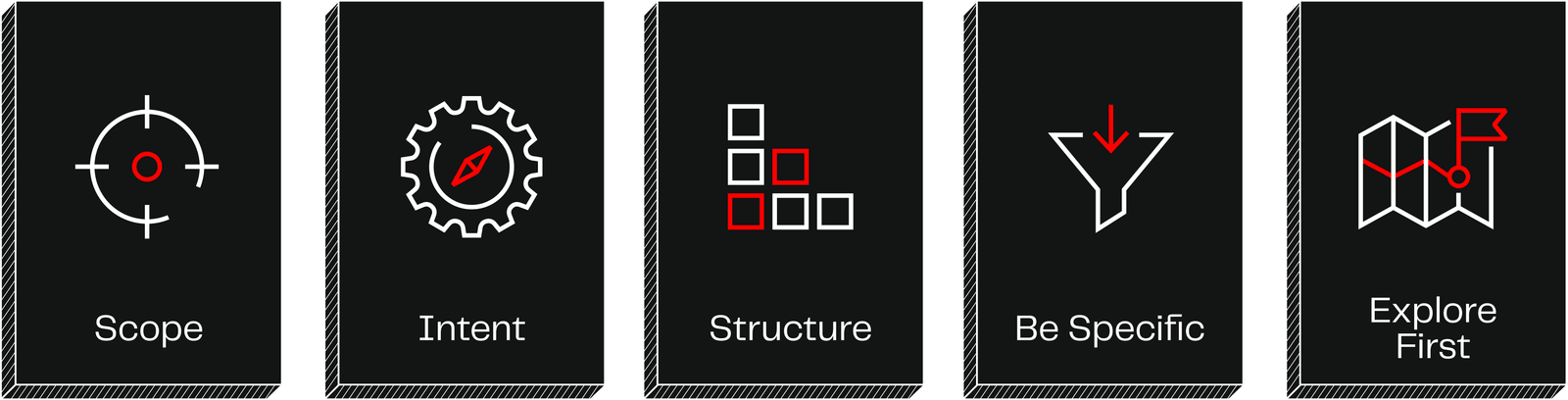
Scope: What are you asking for?
Define the boundaries. What's included, what's not. A prompt without scope is like telling a colleague "handle the project." Technically actionable, but you'll get something you didn't expect.
Vague: "Build me a garden tracker" Scoped: "Add a form that collects plant observations with fields for date, plant name, growth stage, and notes"
Intent: What's it for?
Tell AI why you want it. Intent changes everything. "Build a plant list" could mean a simple text list, a sortable table, a photo grid, or a printable checklist. "Build a plant list that helps me decide what to water when I walk outside each morning" narrows the possibilities dramatically.
Structure: What format should it take?
Tell AI how to organize its output. Want a list? Say so. Want code in a specific framework? Specify it. Want a comparison? Ask for pros and cons. Structure eliminates an entire category of "not what I meant."
Why Specificity Works
Think of words as having neighborhoods of related meanings. When you say "show me my plants," AI considers all the different ways it could show you plants on a website: a table, a photo gallery, a calendar view, a map of your yard. It has to guess which version of "show me" you meant. When you say "build a sortable table of my plants with columns for name, last watered, and sunlight needs," you've collapsed all that ambiguity down to one clear direction.
The pattern: specificity narrows what AI considers. AI has millions of possible responses to any prompt. A vague prompt leaves that space wide open, and AI picks from a vast set of "reasonable" answers. A specific prompt narrows the set to options that are consistently useful.
You don't need to write more words. You need to write more specific words. Every specific word in your prompt narrows the range of possible outputs. That's what the pillars do: Scope narrows where, Intent narrows what, and Structure narrows how.
This is also why the same vague prompt gives you wildly different results each time (probabilistic + unconstrained = maximum variation), but a specific prompt produces results that are reliably close to what you need, even though they're never identical.
Vague vs. Specific
Split & Compare | ~5 minutes total | Split your team into two pairs.
New to pairing? Two people, one computer. The "driver" types while the "navigator" watches, thinks ahead, and catches mistakes. Switch roles frequently so both people get hands-on practice.
Pair A - Open your AI coding assistant and send this prompt:
Tell me about dark fleet vessels
Pair B - Send this prompt instead:
I'm about to build a tool for intelligence analysts that
detects vessels disabling their AIS transponders to evade
sanctions.

Tell me:
- What is AIS and why can vessels turn it off?
- How do sanctioned vessels hide their identity (name changes,
  reflagging, MMSI manipulation)?
- What satellite data sources can detect a vessel at sea when
  its transponder is off?

Format it as a briefing with one paragraph per question and
a summary of key terms (AIS, MMSI, OFAC, VIIRS) at the end.
When you regroup: Pair B, walk your teammates through the key terms from your response at a high level: what AIS, MMSI, OFAC, and VIIRS stand for and why they matter. You do not need the full details yet. These acronyms will come up throughout the rest of today's challenges, and a quick shared understanding now saves time later.
In Your AI Assistant
Paste the prompt directly into your AI assistant terminal.
Paste the prompt directly into your AI assistant terminal.
Paste the prompt directly into Antigravity CLI.
Paste the prompt directly into Codex CLI.
Regroup: Compare what each pair got. How different were the results? Which pair got something closer to what you'd actually want to use? That gap is the power of the three pillars.
Key Insight
The three pillars (Scope, Intent, Structure) aren't about writing more words. They're about writing more specific words. Every specific word narrows the possible outputs. When your results aren't what you expected, check: did you give AI all three? Next, you'll learn a format that delivers all three pillars every time.